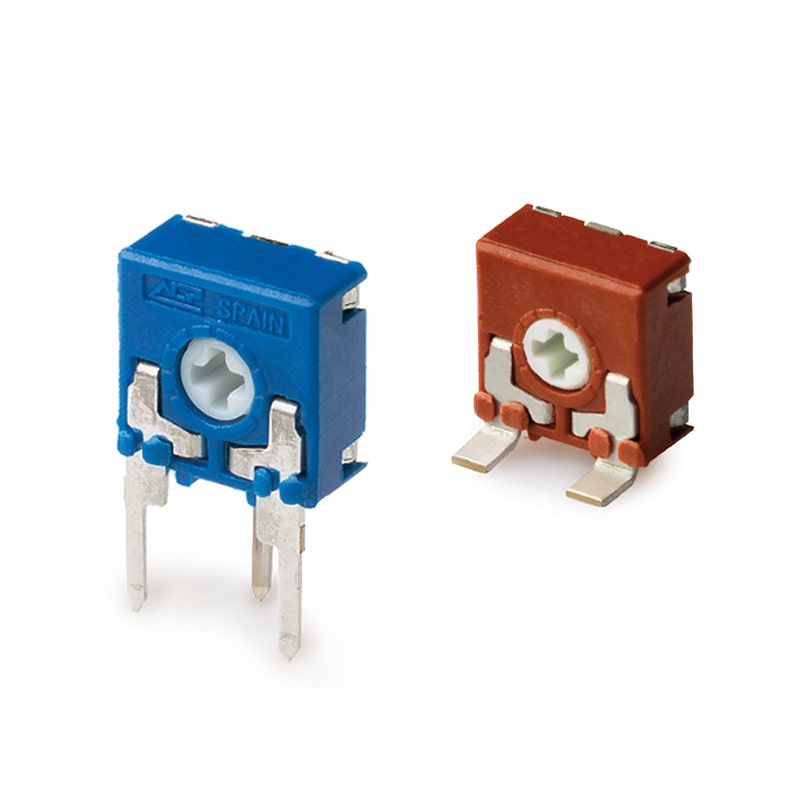
Although the functions of a potentiometer may seem simple—regulating currents or varying voltage levels in an electronic circuit—the reality is that there are different types of potentiometers capable of performing these tasks. Understanding their differences is crucial for design engineers, maintenance technicians, and purchasing managers seeking to optimize the performance and reliability of their systems.
This guide is intended to provide an understanding of the main types of potentiometers, their underlying technologies, and their applications.
Classification of Potentiometers: Key Criteria
Choosing the right potentiometer is not limited to its nominal resistance value. The range available on the market can be classified according to two fundamental criteria that define its performance and use: the technology of its resistive element (the material making up the track) and the mechanical actuation method.
Types of Potentiometers by Resistive Element
The material used for the resistive track is the most critical factor determining a potentiometer’s precision, stability, durability, and performance under various environmental conditions.

Carbon potentiometers
Carbon potentiometers (or carbon composition potentiometers) are the most common and economical type. They use a resistive track made from a mixture of carbon and graphite.
- Advantages: Low production cost. They are ideal for applications where cost is a priority. They can offer extended mechanical lifespans.
- Disadvantages: Greater limitations in power dissipation or exposure to high operating temperatures, and higher ppm (parts per million) variation.
Cermet Potentiometers
The term “Cermet” comes from the combination of “ceramic” and “metal.” These potentiometers use various metal oxides and ceramic compounds as their resistive element.
- Advantages: They offer better thermal stability, higher power dissipation, and can withstand higher operating temperatures than carbon potentiometers.
- Disadvantages: Their initial cost is higher; however, they justify the investment in applications considered critical by customers.
Wirewound Potentiometers
These potentiometers use a resistive wire element and can be single-turn or multi-turn. They are valued for their smooth operation and long rotational life.
- Advantages: Can handle higher power.
- Disadvantages: Older technology and high cost.
ACP
ACP manufactures both carbon and cermet potentiometers using thick-film technology. Thanks to its know-how and extensive experience in this field, ACP can adopt the most precise material configuration for each product, achieving an optimal balance between performance, durability, and cost.
This adaptability allows ACP to effectively meet the most demanding market requirements, offering customized solutions tailored to different applications and operating conditions. Specifically, in the realm of carbon potentiometers, ACP offers a wide range of possible configurations, enabling variants with different resistance characteristics, linearity, and operating temperatures—always aimed at meeting the specific needs of each customer or application.
Types of Potentiometers by Mechanical Actuation
The way the user or circuit adjusts the resistance also classifies potentiometers and defines their application.
Rotary Potentiometers
These are the most familiar type, adjusted via a knob or rotating shaft. The adjustment can be single-turn or multi-turn (for higher precision).
Common Uses: Manual controls in low-power industrial equipment, function selectors in appliances, internal circuit adjustments, brightness or contrast settings on displays, volume controls in audio equipment, and more.
Slide Potentiometers
They have a movable element that slides linearly along the resistive track.
- Common Uses: Frequently found in audio mixing consoles (where they control volume levels per channel) and graphic equalizers, as their visual position provides an immediate indication of the setting.
“Trimmer” or “Trimpot” Potentiometers
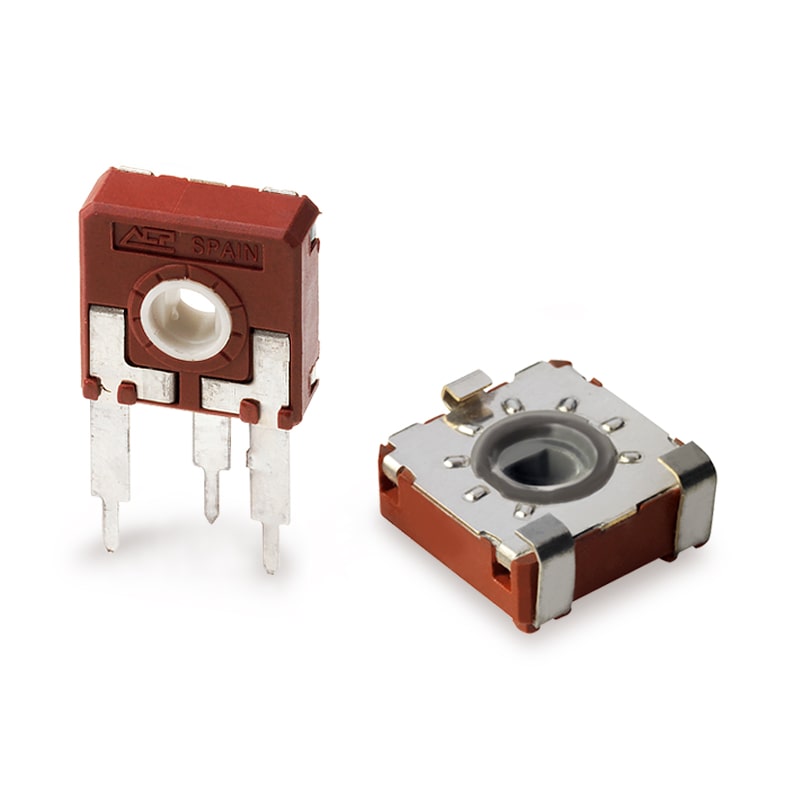
Trimmer potentiometers are compact devices designed to be mounted directly on a printed circuit board (PCB).
Common Uses: They are intended to be adjusted only once (“set and forget”) during calibration or maintenance, unlike control potentiometers, which are designed for frequent use by the end user.
ACP
The potentiometers manufactured by ACP are single-turn rotary potentiometers, which can be configured, among other features, to withstand extended mechanical lifespans (up to 250,000 cycles in some models).
Electrical Curve: Lineal vs. Logaritmic
Beyond classification by technology or actuation, the electrical curve of a potentiometer is fundamental to its performance in specific applications.
- Lineal Potentiometer (Type A): The electrical response curve of a potentiometer varies uniformly (linearly) as the wiper moves along the resistive track. They are ideal for controlling parameters that respond linearly to voltage, such as voltage adjustments, current settings, or positioning.
- Logaritmic and Antilogaritmic (Typo B,C): The resistance does not vary uniformly but follows a logarithmic or antilogarithmic scale. This design mimics human perception of sound, which is logarithmic rather than linear. Such curves are essential in audio and volume applications, since turning the potentiometer halfway does not mean the volume is at half.
ACP
ACP can manufacture potentiometers with linear, logarithmic, or antilogarithmic electrical curves. Additionally, it can control specific characteristics of these curves, such as restrictive linearity within acceptable values for each potentiometer size, as well as other precise electrical parameters required by the application.
Key Industrial Applications of Potentiometers
Potentiometers are critical components in the B2B sector and industrial applications:
- Adjustment in low-power industrial equipment: Used to set values such as delay time or the maximum current passing through equipment like power supplies
- Motor and machinery control: Used to adjust speed, position, and torque in motor control systems, such as in industrial robots or packaging machines.
- User interfaces on control panels: Rotary or slide potentiometers provide intuitive and reliable control for end users.
- Calibration of sensors and measuring equipment: Potentiometers are vital for precise adjustment of the sensitivity of pressure, temperature, and weight sensors.
¿Why Choose Potentiometers from ACP Technologies?
In the field of electronics, the reliability and precision of components are essential. At ACP, our expertise focuses on providing high-quality control solutions with a high degree of customization when required by the client.
Quality and Reliability: ACP is certified under ISO 9001:2015, ISO 14001:2015, and IATF 16949:2016, ensuring that our products meet the strictest industrial standards for optimal performance and long service life.
Customization Capability: We understand that each project has unique requirements. We offer tailored solutions and a wide range of options to suit the specific needs of your design.
Sustainability: ACP is certified under ISO 14001:2015, reflecting our commitment to systematically identify, manage, and reduce the environmental impact of our manufacturing activities.
Choosing the right type of potentiometer is a strategic decision that directly impacts the functionality and reliability of your final product. From economical carbon potentiometers to robust cermet potentiometers, each type has a clear purpose.
Investing in quality components ensures not only the expected performance but also the long-term durability of your system.