In the vast universe of electronics, there are thousands of complex components performing amazing tasks. But beneath all that complexity lies a fundamental foundation. Passive components are the silent “bricks and mortar” on which every electronic circuit is built, from your phone charger to an airplane’s control systems.
But what exactly are these components? How do they differ from their counterparts, active components, and why, despite their apparent simplicity, are they so crucial for any electronic design? This article will explain it clearly, without unnecessary jargon, so you can master the foundations of electronics.
The Fundamental Distinction: Passive vs. Active Components
To understand what a passive component is, it’s easiest to first get to know its opposite. Electronics is divided into two main families of components: passive and active.
- Passive Components: These are components that cannot generate energy gain or control the flow of current through another electrical signal. Their only function is to consume, store, or dissipate the energy supplied to them. Think of them like a city’s plumbing system: they can regulate the flow (a narrow pipe) or store it temporarily (a reservoir), but they cannot add more water to the system on their own.
- Active Components. These are components that can control the flow of current and, more importantly, can amplify an electrical signal (generate gain). They require an external power source to operate. Following the analogy, an active component is like a water pump or an electrically controlled valve: it can increase pressure (amplify) or open and close the water flow at will. Clear examples include transistors, diodes, and integrated circuits.

The 3 Fundamental Passive Components (and Their Derivatives)
All of passive electronics is built on three pillars. Understanding these three components is understanding 90% of the principles that govern circuits.
1.- Resistors: The Regulators of Electric Flow
- Function: The role of a resistor is simple yet vital: to oppose the flow of electric current. By providing this resistance, they allow for the control and regulation of voltage and current levels throughout a circuit, protect more sensitive components, and create voltage dividers.
- Special Case: Potentiometers. One of the classic electrical uses of a potentiometer is as a variable resistor. Instead of having a fixed value, its resistance can be adjusted manually, allowing dynamic control over a circuit. This makes them ideal for HMI systems (dimmers, small motor speed regulation) and precision calibration. Increasingly, potentiometers are also used in electronic applications as voltage dividers. Their integration with microcontrollers has effectively adapted this classic analog component to the digital age. How? The voltage level from the potentiometer feeds a single input of the microcontroller’s ADC port, converting the analog signal into digital form. This allows a low-cost component like a potentiometer to be used in today’s sophisticated applications. To learn more, explore the different types of potentiometers in depth.
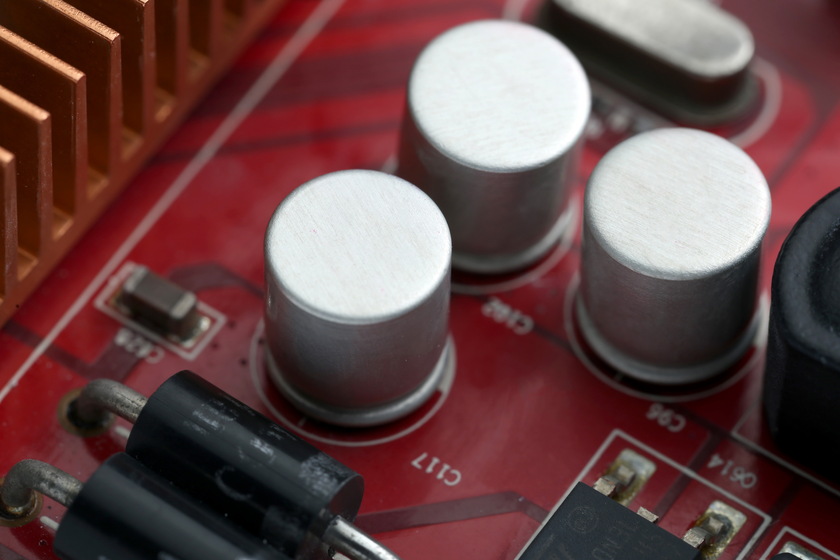
2.- Capacitors (or Condensers): The Temporary Energy Stores
- Function: A capacitor acts like a miniature, ultra-fast rechargeable battery. Its role is to store energy in an electric field and release it when the circuit requires it.
- Common Applications: They are essential for filtering “noise” in power supplies, creating timing circuits, smoothing signals, and storing short-term energy in all kinds of applications.
3.- Inductors: The Magnetic Energy Reserves
- Function: While a capacitor stores energy in an electric field, an inductor stores it in a magnetic field generated when electric current passes through its coil. They are particularly effective at opposing changes in current.
- Common Applications: They are widely used in high-frequency filters, in transformers (which use two or more inductors), and as key components for storing and transferring energy in modern switched-mode power supplies.
The potentiometer in the digital age
The potentiometer has been part of electronics since its origins. For decades, it was used in radios, televisions, and amplifiers as a simple volume control.
Today, this low-cost component has become an ally of microcontrollers, functioning as an adjustable voltage divider that bridges the analog and digital worlds.
How is this possible?
The first key concept to understand is that a potentiometer always provides an analog signal. However, this signal can be digitized by connecting it to a microcontroller’s ADC port. This allows most modern digital devices to use the potentiometer as a cost-effective and reliable option in sophisticated applications.
For this to work, the potentiometer must be used electrically as a voltage divider within the electronic circuit.
For example, in a 10-bit ADC, a voltage between 0 and 5 V is translated into values from 0 to 1023. Turning the potentiometer not only adjusts a circuit but also provides the digital system with a simple way to receive continuous and precise information.
Modern Applications
What once served to increase or decrease volume is now part of much more advanced systems across major markets:
- Industrial: safety relays, power supplies, multichannel circuit breakers…
- Home Appliances: washing machines, dryers, blenders, vacuum cleaners…
- Building Automation: thermostats, ventilation, air conditioning…
- Automotive: HVAC systems
- Calibration and Test Equipment
A Classic Reimagined
The fascinating part is that this low-cost component has been integrated without losing its essence. The potentiometer remains analog, but when connected to a microcontroller, it takes on a digital role, functioning as a bridge between the physical and logical worlds, especially in HMI systems.
In short, the potentiometer is proof that in electronics, classics never die—they simply evolve and adapt to new technological needs.
Summary Table: Passive vs. Active Components at glance
For a quick visual comparison, this table summarizes the key differences.
| Features | Passive Components | Active Components |
| Power Source | No external power required | Requires external power |
| Power Gain | No (Attenuate or Dissipate) | Yes (Can Amplify) |
| Signal Control | Do Not Control Flow | Yes, via a control signal |
| Main Function | Store, Dissipate, Filter | Amplify, Switch, Process |
| Examples | Resistors, Capacitors, Inductors | Transistors, Diodes, ICs |
¿Why the Quality of Passive Components Is Crucial?
This is a point well understood by experienced engineers. Although they may seem “simple” or less glamorous than a microprocessor, the reliability, precision, and durability of a final product depend directly on the quality of its passive components.
A low-quality resistor that changes value with temperature can miscalibrate sensitive medical equipment. A potentiometer in an industrial control panel that loses precision or fails due to vibration can cause production downtime—or, worse, an accident. The failure of a component that costs very little on a PCB can lead to the failure of a system worth thousands.
This is where materials engineering and manufacturing expertise from companies like ACP make a difference. ACP specializes in the design, manufacturing, and marketing of passive components—mainly resistive potentiometers using carbon or cermet technology—as well as position sensors and various custom electromechanical solutions. ACP products are based on thick-film technology and are specifically designed to meet the most demanding market conditions (special soldering processes, various operating temperature ranges, strict linearity requirements, etc.).
Conclusion
Understanding passive components is mastering the fundamental language of electronics. They are the non-powered foundation upon which all technological innovation is built. As we have seen, their three main types—resistors, capacitors, and inductors—perform irreplaceable functions, and their quality should never be underestimated.
Understanding this foundation is not just theoretical; it is the first and most important step in designing, building, and maintaining electronic systems that are truly robust, reliable, and safe.
Using the potentiometer as a voltage divider provides the digital age with a highly competitive component for sophisticated applications with HMI systems.
Now that you know the fundamentals, do you want to see how they are applied in high-precision components? Explore our range of potentiometers or contact our team to discuss the requirements of your next design.